The MAENA project is driving the restoration of the Small Water Cycle (SWC) by establishing specialized demonstration farms across Tunisia, Lebanon, and Italy. These sites will serve as a “proof of concept” for sustainable practices that will be scaled up and deployed across around twenty private farms in partner countries (Tunisia, Jordan, Lebanon, Italy, and Spain)
The field actions focus on four critical pillars: water conservation, soil remediation, water-energy nexus solutions, and advanced monitoring.
In Tunisia, the project is being implemented across three key institutional sites:
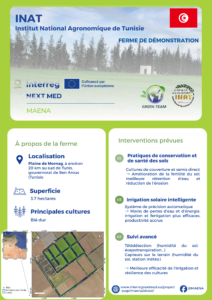
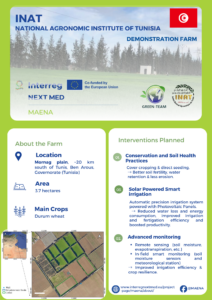
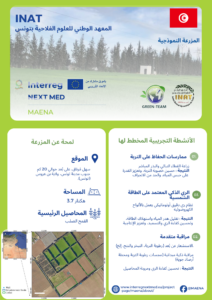
- INAT (Institut National Agronomique de Tunisie) demonstration farm will prioritize conservation and soil health practices. Key interventions include the use of cover cropping and direct seeding, which are designed to enhance soil fertility, improve water retention, and significantly reduce erosion. To complement these soil-based practices, the farm will be equipped with a solar-powered smart irrigation system. This automatic precision system will utilise photovoltaic panels to simultaneously reduce water loss and energy consumption, while boosting overall crop productivity.
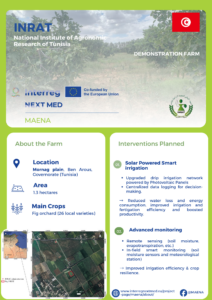
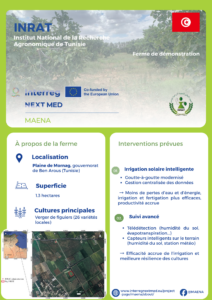
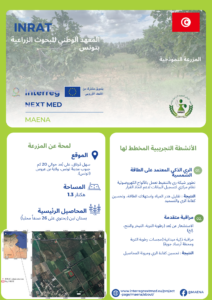
- At INRAT (Institut National de Recherche Agronomique de Tunis) demonstration farm, the primary objective is the implementation of a high-tech, upgraded smart irrigation system. This facility will feature a modern drip irrigation network specifically designed for the farm’s fig orchard, which hosts 26 local varieties. To ensure data-driven management, the system will include centralised data logging for informed decision-making. These interventions aim to minimise water and energy waste while maximising the efficiency of both irrigation and fertigation.
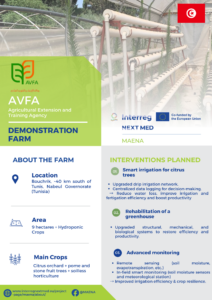
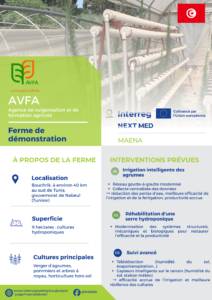
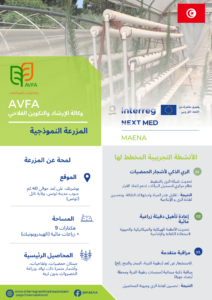
- At the selected AVFA (Agence de la vulgarisation et de la formation agricoles) demonstration farm, MAENA project will set up a smart irrigation system specifically for the citrus trees, supported by centralised data logging to optimise resource use. Additionally, an existing hydroponic greenhouse will be rehabilitated, where upgraded structural and mechanical systems enable smart fertigation and precise climate control to restore efficiency and boost yields.
All Tunisian Demonstration farms will utilise a combination of on-field sensors and remote sensing tools (provided by the partner isardSAT). These tools track parameters like soil moisture and evapotranspiration to serve as a decision-support platform for efficient resource management.
Beyond technology deployment, these demonstration farms serve as educational hubs, providing students and agricultural professionals with hands-on training on sustainable farming techniques.
Information sheets outlining key information about each demonstration farm, in english, french and arabic, are attached